How often do Amazon competitors follow a price cut? We measured 1.86 million chances
What competing sellers did after each of our price cuts on Amazon over four months: most did nothing, and the ones that responded did it consistently.
By the PriceOptimizer Pro team · Updated · 6 min read
When you cut a price on Amazon to win the Buy Box, what your competitors do next decides whether the cut was worth it. If they match you within the hour, you have given away margin for nothing. If they don't, the cut can win you sales for days.
Most repricing advice assumes every competitor responds. We wanted to know how often they actually do, so we measured it.
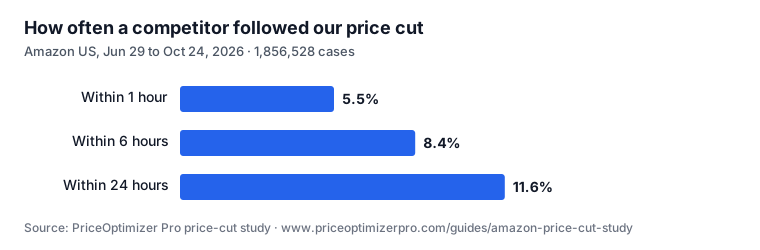
Short answer: rarely. Across 1,856,528 cases on the Amazon US marketplace between June 29 and October 24, 2026, a competitor lowered its own price within six hours of our price cut only 8.4% of the time. The exceptions are predictable: the Buy Box holder, competitors on listings with few sellers, and the small group that follows almost every cut.
Key findings
- 8.4% of competitors lowered their price within 6 hours of our cut (5.5% within an hour, 11.6% within a day).
- Among those that followed within a day, 47% did so within the hour, and a quarter within 15 minutes.
- Of the competing offers with at least 10 chances to respond, 75.9% never followed and 9.0% followed half the time or more.
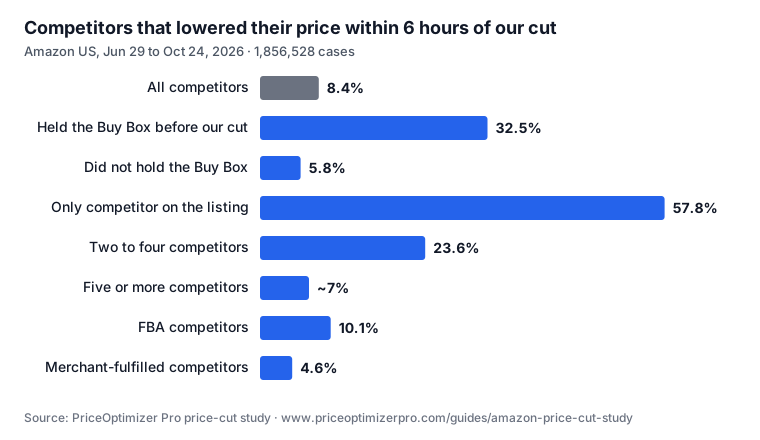
- A competitor that held the Buy Box followed 32.5% of the time, against 5.8% for one that didn't.
- On a listing with a single competitor, it followed 57.8% of the time; with five or more competitors, around 7%.
What we measured
Between June 29 and October 24, 2026, we recorded every price change on the listings in our own Amazon US catalog, 620 products, along with the price of every competing offer on each listing. Each time we lowered a price, we checked what each competitor on that listing did over the next 24 hours.
That gave us 1,856,528 cases of "we cut our price, and this competitor was there to respond", from 190,070 price cuts, across 7,212 competing offers from 186 sellers.
How often do competitors follow a price cut?
Mostly they don't. Within 6 hours of our price cut, 8.4% of competitors lowered their own price. Within one hour, 5.5%. Within a full day, 11.6%.
Put the other way: after 91.6% of our cuts, a given competitor did nothing at all for the next six hours.
How quickly do the ones that follow react?
Quickly. Among competitors that did respond within a day, a quarter did so within 15 minutes, and almost half (47%) within the hour. Responses that quick suggest repricing software rather than a person checking prices. The rest were slower: half took longer than 73 minutes, and a quarter more than seven hours.
And they are creatures of habit
The strongest pattern in the data is how consistent each competitor is. Of the 5,837 competing offers that had at least 10 chances to respond to our cuts:
| How often it followed within 6 hours | Share of competitors |
|---|---|
| Never | 75.9% |
| Less than 10% of the time | 85.6% |
| Between 10% and 50% | 5.4% |
| Half the time or more | 9.0% |
| 90% of the time or more | 4.5% |
So most competitors almost never respond, a small group respond most of the time, and very few sit in between.
That consistency makes competitor behaviour predictable. When we tested it on a week of data held out from training, a competitor's own past follow rate alone predicted whether it would follow our next cut with an accuracy (AUC) of 0.97, where 1.0 would be perfect and 0.5 no better than a coin toss.
Which competitors are most likely to follow?
- Who holds the Buy Box. Competitors that held the Buy Box before our cut followed it within 6 hours 32.5% of the time, against 5.8% for those that didn't: more than five times as often. The seller you are trying to take the Buy Box from is the one most likely to answer.
- How crowded the listing is. On listings with just one competitor, that competitor followed within 6 hours 57.8% of the time (a smaller group in our data: 78 competing offers). With two to four competitors, 23.6%. With five or more, around 7%.
- Fulfillment. FBA competitors followed within 6 hours 10.1% of the time; merchant-fulfilled ones 4.6%, less than half as often.
Charts may be reused with a link to this page.
What it means for your repricing
- Don't assume every competitor responds. Most of the time, most don't. A small cut against a competitor that never follows can win the sale.
- Expect a fight on quiet listings, and from the Buy Box holder. One-on-one, or against the seller holding the Buy Box, a cut is far more likely to be answered. That is where price wars start, and where matching is often the better move.
- Know which competitors follow. Against a competitor that follows nearly every cut, undercutting only lowers both your prices. Because competitors are so consistent, how one has responded before is the best guide to how it will respond next.
- Set a floor either way. Whatever a competitor does, a minimum price from your costs is what stops a run of cuts from eating your margin.
This is what AI Competitor Insights in PriceOptimizer Pro is built on: for each competitor on a listing, it shows the chance that competitor follows your price cut within six hours, and how quickly it usually reacts, from a model trained and tested on this price history. Your prices are still set by the rules and limits you choose. See AI Competitor Insights.
The limits of this data
- It comes from one seller's catalog of 620 listings on the Amazon US marketplace, over about four months. Other categories, catalogs and marketplaces may behave differently.
- Prices were read from snapshots: to the minute when Amazon notified us of a change, otherwise to within about an hour.
- A competitor dropping out of the top 20 offers Amazon reports on a listing can look like it disappeared.
- Our price cuts tend to come in bursts, so cases close together in time are not independent of each other.
- The 0.97 accuracy comes from our model's evaluation on a held-out week of the data up to late September.
- "Followed" means the competitor lowered its price after our cut. We can't see why it did, only that it did.